Old Stone, New Funk: The Ancient Cellars Quietly Reshaping British Beer
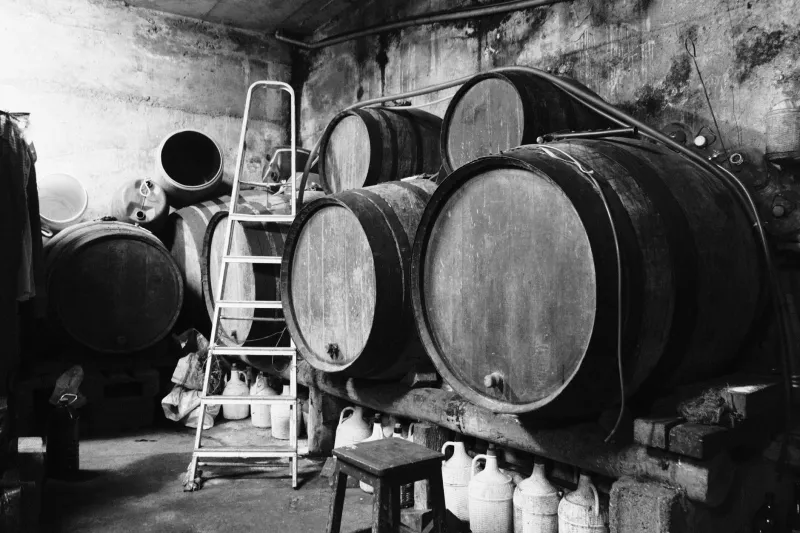
The stairs are narrow and the ceiling is low. The air hits you immediately — cool, damp, and carrying something between vinegar, stone fruit, and old wood. It smells, faintly, of time. Down here, in a cellar that predates the brewery above it by at least a century, barrels are stacked three high and the conversation is conducted in whispers, as if raising your voice might disturb whatever is quietly happening inside the casks.
This is not Belgium. This is not the American Pacific Northwest. This is a working brewery in the north of England, and what's ageing in these barrels represents one of the most quietly exciting shifts in British brewing in a generation.
Heritage as Infrastructure
Britain's oldest breweries were not designed with the twenty-first century in mind. Their cellars were built for cold storage and lagering at a time when refrigeration was a fantasy, their stone walls thick enough to hold a near-constant temperature through summer and winter alike. The timber joists, the flagstone floors, the centuries of microbial life embedded in the brickwork — none of this was considered an asset when modern brewing took over. It was, at best, a quirk. At worst, a liability.
Now, brewers are looking at that same infrastructure with entirely different eyes. The uncontrolled microbial environment that once made hygiene officers nervous turns out to be precisely what wild and mixed-fermentation beer requires. The cool, stable temperature that made Victorian cellars ideal for cask conditioning makes them equally ideal for long, slow barrel ageing. The very antiquity of these spaces — their accumulated history — is, it turns out, an ingredient.
Yorkshire: Where Gritstone Meets Wild Yeast
In the West Riding of Yorkshire, a handful of breweries operating out of Victorian mill buildings and converted farmsteads have begun running barrel programmes that would have seemed extraordinary a decade ago. Using old whisky and wine casks sourced from Scotland and the continent, they're ageing stouts, saisons, and experimental mixed-fermentation ales in cellars where the ambient temperature rarely exceeds twelve degrees.
The results are striking. Long-aged imperial stouts take on characteristics from the spirit-soaked oak — vanilla, dried fruit, a leathery depth — while the stone cellar environment introduces a mineral quality that brewers in purpose-built facilities simply can't replicate. One brewer in the Calder Valley, who began his barrel programme with a single ex-bourbon hogshead, now runs over forty casks in a space that was, until recently, used for storing broken pallets.
"The cellar did most of the work," he says, with the particular understatement of a Yorkshireman. "We just had to stop being frightened of it."
Cornwall: Granite Walls and Funky Farmhouse Ales
At the other end of the country, Cornish brewers are finding similar inspiration in a very different landscape. Several small-scale operations in the far west — working out of converted engine houses and old farm outbuildings — have begun producing mixed-fermentation ales that draw on both the local microbial environment and the distinctive mineral character of granite-built spaces.
The Cornish brewing scene has always had a strong identity, shaped by geography and a certain proud remoteness from mainland trends. But the wild ale movement fits here with surprising ease. There's a tradition of farmhouse fermentation in the region that, while not as formally documented as Belgian lambic culture, shares its underlying logic: use what's around you, embrace what you can't control, and trust that the place itself will shape the flavour.
Some of these Cornish wild ales have begun appearing at specialist beer festivals and bottle shops, where they're attracting serious attention from buyers who'd previously looked only to continental Europe for this style. The acidity is different here — less sharply lactic than some Belgian examples, with a broader, rounder sourness that takes its time. The granite, some argue, is responsible. Others credit the sea air. Most brewers simply shrug and say they're still learning what their cellar wants to do.
The Science Behind the Stone
It would be easy to romanticise all of this — and there is, undeniably, a romantic dimension to the idea of ancient walls actively participating in the brewing process. But the microbiology is real. Old stone and timber structures harbour complex communities of wild yeast and bacteria: Brettanomyces strains, Lactobacillus, Pediococcus, and others that interact with fermenting beer in ways that are genuinely difficult to predict or standardise.
For brewers trained in the modern tradition — where consistency is king and wild fermentation is a contamination risk — this represents a significant philosophical shift. Mixed-fermentation beer cannot be fully controlled. Each batch is, to some degree, a negotiation between the brewer's intentions and the cellar's own agenda. Some batches disappoint. Others exceed every expectation. The acceptance of that uncertainty is, perhaps, the most radical thing about the movement.
Blending the Old with the Experimental
What makes the British iteration of this trend particularly interesting is the way it's being grafted onto existing brewing traditions rather than imported wholesale from abroad. Several of the breweries involved in barrel-ageing programmes also produce traditional cask ales — and the same cellars that house experimental sour beer are often home to perfectly conventional best bitters conditioning in steel tanks.
This isn't a rejection of British brewing heritage. If anything, it's an extension of it. The patience required for barrel-ageing and wild fermentation is not so different from the patience that has always characterised the best cask ale producers — the understanding that good beer cannot be rushed, that time is an ingredient, and that the environment in which beer matures is as important as what goes into the copper.
Breweries like Burning Sky in Sussex and Wild Beer Co in Somerset have demonstrated that this approach can find a genuine audience in Britain, not just among the adventurous craft beer crowd but among drinkers who simply want something with depth and character. The success of their barrel programmes has encouraged others, and the number of UK breweries running serious ageing projects has grown considerably over the past five years.
What the Cellars Are Saying
There's a question that hangs over all of this, and it's worth asking plainly: is Britain actually developing its own wild and barrel-aged beer identity, or is it just doing a creditable impression of Belgium and the United States?
The honest answer is: a bit of both, and that's fine. Every brewing tradition begins somewhere else and becomes itself over time. What's clear, from conversations with brewers working in these old spaces, is that the results they're getting are distinctively British in character — shaped by local water chemistry, local microflora, local wood, local stone. The flavours emerging from a cellar in Huddersfield are not the same as those emerging from a lambic producer in the Pajottenland, even when the process is superficially similar.
Britain's brewing future, it turns out, may owe rather a lot to its brewing past. The oldest rooms in the oldest breweries are producing some of the most genuinely original beer in the country right now. You just have to be willing to go downstairs to find it.