Brewing on Their Own Terms: The Women Changing What British Beer Looks Like
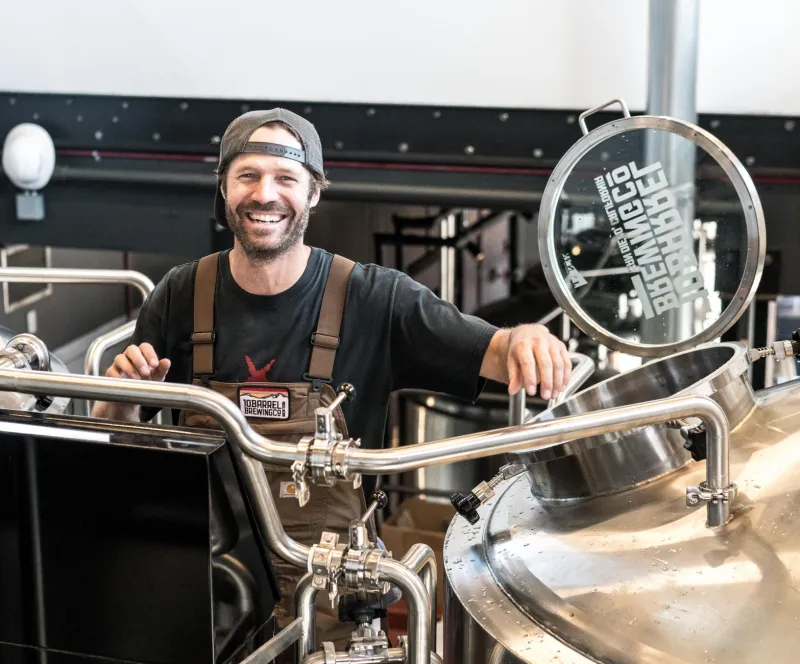
Ask most people to picture a British brewer and there's a reasonable chance the image that comes to mind is fairly specific. Male, probably bearded, possibly wearing a checked shirt. It's a cliché, and like most clichés it contains a grain of historical truth. But it is, increasingly, out of date.
Across the UK, women are founding breweries, leading fermentation programmes, and building communities around beer that look and feel quite different from the traditional model. Some are doing it quietly, letting the liquid speak for itself. Others are being deliberately visible, aware that representation matters and that someone needs to be in the room for things to change. All of them are worth knowing about.
This isn't a piece that wants to be patronising about any of that. These are simply excellent brewers who happen to be women, working in an industry that hasn't always made space for them, and making beer that deserves a serious audience.
Starting From Scratch in Rural Wales
When Rhiannon Davies left a head chef position at a restaurant in Cardiff to set up a one-barrel brewery in the Brecon Beacons, most people thought she'd lost the plot. That was four years ago. She now produces some of the most food-forward, ingredient-led farmhouse ales in Wales, with a waiting list for her quarterly mixed-fermentation releases.
The crossover from cooking to brewing is less unusual than it sounds. Both disciplines are fundamentally about flavour — understanding how ingredients interact, how time and temperature change things, how to coax complexity from simplicity. Davies describes her approach to recipe development in terms that would be familiar to any serious chef: seasonal, intuitive, built around what's available locally rather than what's fashionable nationally.
"I'm not trying to make beers that taste like other beers I've had," she says. "I'm trying to make beers that taste like this place, at this time of year." The results — a late-summer saison brewed with foraged elderflower and meadowsweet, a winter farmhouse ale aged in ex-whisky casks from a nearby distillery — bear that out entirely.
The barriers she encountered setting up were partly practical and partly cultural. Funding was difficult. Suppliers occasionally assumed she was placing orders on behalf of someone else. Early on, a distributor suggested she might want a male business partner to "front" the brand at trade events. She declined.
The Biochemist and the Sour Programme
In Lancashire, a different story is playing out. Dr Priya Mehta spent a decade working in pharmaceutical research before a fairly dramatic career pivot brought her to craft brewing. The scientific background, she says, was directly transferable — perhaps more so than in any other area of brewing, sour beer production rewards a rigorous, methodical approach.
Her brewery, a small but growing operation outside Clitheroe, has built a national reputation for its mixed-culture fermentation programme. The beers are precise without being clinical, with a complexity that takes several sips to fully appreciate. A recent Flanders-style red ale — eighteen months in barrel, blended across three vintages — picked up considerable attention at last year's SIBA judging, and rightly so.
Mehta is candid about the experience of being a woman of colour in a space that is overwhelmingly white and male. "The beer is what opens doors," she says. "But you do notice when you walk into a room and people are surprised by who made it."
She's become an advocate for better mentorship and clearer pathways into the industry for underrepresented groups, working with several brewing colleges to develop outreach programmes. It's unglamorous work, the kind that doesn't get written up in beer magazines, but she describes it as inseparable from what she does at the brewery.
Building Community in the Northeast
Not everyone we spoke to fits the founder-brewer model. In Newcastle, Joanne Whitfield has built something arguably more ambitious: a cooperative taproom and brewing collective that exists specifically to support women and non-binary people entering the industry.
The project, which operates from a converted railway arch, functions partly as a commercial brewery and partly as a training ground. Whitfield, who has been working in the industry for over a decade across various roles, describes the impetus as straightforward. "I kept meeting brilliant women who wanted to get into brewing and had no obvious way in. The industry isn't great at structured training, and informal networks tend to replicate whoever's already in the room."
The collective has so far helped place over twenty people into brewing roles across the northeast, several of whom have gone on to head-brewer positions. The beers they produce — a rotating range of lagers, pale ales, and seasonal specials — are sold through the taproom and a small number of local accounts.
How Far There Is Still to Go
It would be dishonest to write a piece like this without acknowledging that the progress, while real, is uneven. Women remain significantly underrepresented in senior brewing and ownership roles across the UK industry. Harassment and dismissiveness — both overt and subtle — are still common experiences. Several people we spoke to for this piece declined to be quoted by name, citing concerns about professional consequences.
The Cyclops beer description scheme and various SIBA initiatives have made some effort to address diversity in recent years, but structural change is slow, and good intentions don't automatically translate into better outcomes for people working at the coalface.
What's harder to deny, though, is the quality and creativity of what's being produced. The breweries we've mentioned here, and dozens like them across the country, are making beer that stands on its own merits — beer that would be worth seeking out regardless of who made it.
That, ultimately, is the point. Not to celebrate women in brewing as a novelty or a category, but to recognise that British beer is richer, stranger, and more interesting because of the people who are now making it. Go find their work. It's worth the effort.