Snack Seriously: The Pubs Treating Bar Food as Thoughtfully as Their Tap List
There's a particular kind of disappointment that any seasoned pub-goer knows well. You've ordered something genuinely special — a properly conditioned pale ale, maybe, or a cloudy farmhouse saison that's been travelling down from a small-batch brewery in Northumberland — and then you reach for the snack rack. Cheese and onion. Prawn cocktail. The same six brands that have been hanging on wire hooks in British pubs since roughly 1987.
Not that there's anything wrong with a bag of crisps. But when a landlord has spent serious time and money curating a tap list that tells a story, it does seem a shame to let the narrative fall apart the moment someone gets peckish.
A growing number of pubs across the UK are doing something about that. They're approaching bar snacks — proper, considered, artisan bar snacks — with the same philosophy they bring to their beer selection. The results are worth travelling for.
Why Pairing Actually Matters
Before we get into specifics, it's worth addressing the sceptics. Pairing beer with food can sound a bit precious, the sort of thing that belongs in a tasting room rather than a proper pub. But the logic is straightforward and, once you've experienced a good match, difficult to argue with.
Beer is enormously varied in flavour — far more so than most people give it credit for. The roasted, almost coffee-dark bitterness of a robust porter has almost nothing in common with the sharp, citrus-forward brightness of a New England IPA, which in turn is a world away from the gentle funk and stone-fruit complexity of a well-made farmhouse ale. Food interacts with all of those flavours. The right snack can lift a beer, draw out hidden notes, or provide contrast that makes both things taste better than they would alone.
This isn't new thinking in fine dining. But in pubs, it's still relatively radical — which is precisely what makes the landlords pursuing it so interesting.
The Sourdough Question
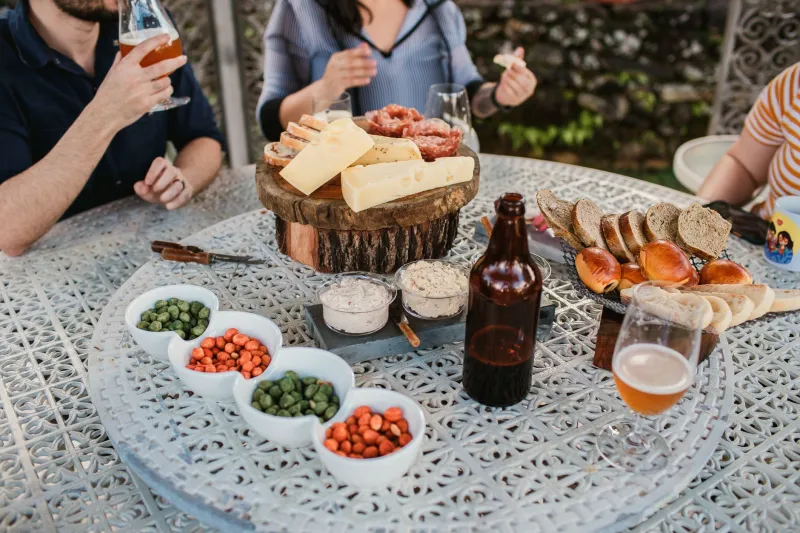
In several of the pubs we visited while researching this piece, sourdough crackers kept appearing. Not bread — crackers. Thin, blistered, with enough structural integrity to carry something on top, and enough neutral character not to bulldoze whatever they're served alongside.
The reason they work so well in a beer context is their versatility. Spread with a sharp, unpasteurised farmhouse cheese, they're a natural companion to saisons and grisettes — styles where the slight tartness and earthy, hay-like quality of the beer finds an echo in the dairy. Topped with something richer, like a smoked duck pâté or a well-aged cheddar with proper bite, they hold their own against bigger, maltier beers without disappearing entirely.
One bar manager we spoke to, working at a free house in the Yorkshire Dales, described their cracker-and-cheese board as "the conversation starter for the tap list." The idea being that what you eat shapes what you order next, and vice versa. It's a loop, and once you're in it, you tend to stay longer and drink more thoughtfully.
Charcuterie and the Porter Problem
If sourdough crackers are the polite, flexible option, smoked charcuterie is where things get genuinely bold. A proper board — cured meats, smoked sausage, perhaps some pickled walnuts or cornichons — brings a saltiness and intensity that can overwhelm subtler beers entirely. But match it with a robust porter or a Baltic-style stout, and something clicks.
The smoke in the meat finds a companion in the roasted grain character of the beer. The fat in the charcuterie softens the bitterness. The salt makes you want another sip. It's not a complicated equation, but it's an extremely satisfying one.
Pubs in Manchester, Bristol, and Edinburgh have all been experimenting with this pairing in recent years, often sourcing their meats from British artisan producers — outfits doing proper slow-cure work in places like Somerset, Suffolk, and the Scottish Borders. The localism matters, not just ethically but flavourwise. British-cured meats tend to be less aggressively seasoned than their continental counterparts, which gives the beer more room to express itself.
The Practical Side: Making It Work Behind the Bar
Of course, there are real operational challenges to doing this well. A kitchen is one thing. A bar top is another. Most pubs don't have the staff, the prep space, or the refrigeration to run an elaborate snack programme alongside a full food menu.
The landlords getting this right tend to keep things simple and focused. A rotating selection of three or four items, changed with the seasons and the tap list, rather than a sprawling menu that's difficult to execute consistently. Partnerships with local producers who can deliver small quantities of high-quality goods regularly. And crucially, staff who understand what they're serving and can talk about it without sounding like they're reading from a script.
That last point is more important than it sounds. The best pairing in the world falls flat if the person behind the bar can't explain why it works. Enthusiasm is contagious, and a brief, genuine recommendation — "that saison goes brilliantly with the aged goat's cheese, if you fancy it" — does more for the experience than any printed menu card.
What This Means for the Pub-Goer
If you're a regular reader of Beer Lover Cam, you're probably already paying close attention to what's on the pump. The suggestion here is simply to extend that attention a few inches to the left, towards whatever's sitting on the bar top.
When a pub has clearly thought about its snacks, it's usually a signal that it's thought carefully about everything else too. It's a small but telling detail — like well-kept lines, or glasses that don't smell of the dishwasher. It tells you that the person running the place cares about the whole experience, not just the headline act.
And honestly, after a long week, there are worse things than settling in with a proper pint, a board of something interesting, and the dawning realisation that the two have been quietly made for each other.